

Direct answer: Increase coaching admissions by making the learning experience easier to understand and trust. Show how your faculty teaches, how students practise and improve, what parents can expect, and how hostel and support services work. Then connect every enquiry to a relevant demonstration and a clear, respectful next step.
First, calculate the enquiries needed for your admissions target
If you want to increase admissions in your coaching institute, begin with the conversion you already achieve. For a consistent enquiry cohort, divide confirmed admissions by total enquiries to get your enquiry-to-admission conversion rate. Then divide the next admission target by that rate to estimate the enquiries required.
For example, if 300 enquiries led to 30 admissions, the conversion is 10%. To reach 60 admissions at that conversion, you would need approximately 600 enquiries in the next 30 days (about 20 a day). If better counselling and follow-up raised conversion to 15%, the same target would require around 400 enquiries (about 14 a day). These are planning scenarios, not industry benchmarks or guaranteed outcomes.
Try your own numbers: Use the free 15-second Coaching Admissions Calculator for instant estimates. The optional advanced version also shows interested-lead conversion, acquisition cost per admission and break-even. For the next practical step, use our 7-day admissions follow-up guide and free tracker.
What happened
In a 12 August 2026 parliamentary update, the Ministry of Education highlighted coaching-centre transparency, including tutor qualifications, course details, fees and student outcomes. Separately, a 15 May 2026 CCPA release described action against misleading coaching advertisements that concealed which courses successful students actually attended. These are dated developments, not a new announcement this week. They reinforce a practical question: can families verify the value your admissions team promises?
The facts above are reported context. The framework below is Shikha Solutions’ interpretation for coaching owners; it is not a survey of parent preferences or a compliance checklist.
Why coaching owners should pay attention
A parent may ask about fees while worrying about something else: Will my child understand the teaching? Who will notice if they fall behind? Will they be safe away from home?
Treat these as questions to investigate, not assumptions about every family. Ask the student too. A convincing sales conversation connects the learner’s actual needs with support the institute can deliver.
More enquiries cannot repair an unclear offer. If a prospect receives only a brochure, a topper poster and repeated payment reminders, the admissions team has left the difficult questions unanswered.
What owners commonly misunderstand
More services automatically mean more value. Adding an app, extra lectures or a hostel is useful only when it solves a real student problem and works consistently.
A famous faculty name explains the learning experience. Families also need to know who teaches their batch, how doubts are resolved and what happens when a concept is not understood.
Results speak for themselves. A selection count without the year, cohort and course context can create the wrong impression. Separate test-series participation from full classroom coaching. Never turn a past result into a guarantee.
The Shikha Solutions 7P Admissions Confidence Check
Score each area: 0 = unclear or unavailable; 1 = explained but inconsistently delivered or evidenced; 2 = clear, evidenced and assigned to an owner. The total is out of 14. This is an internal diagnostic, not a validated predictor of admissions.
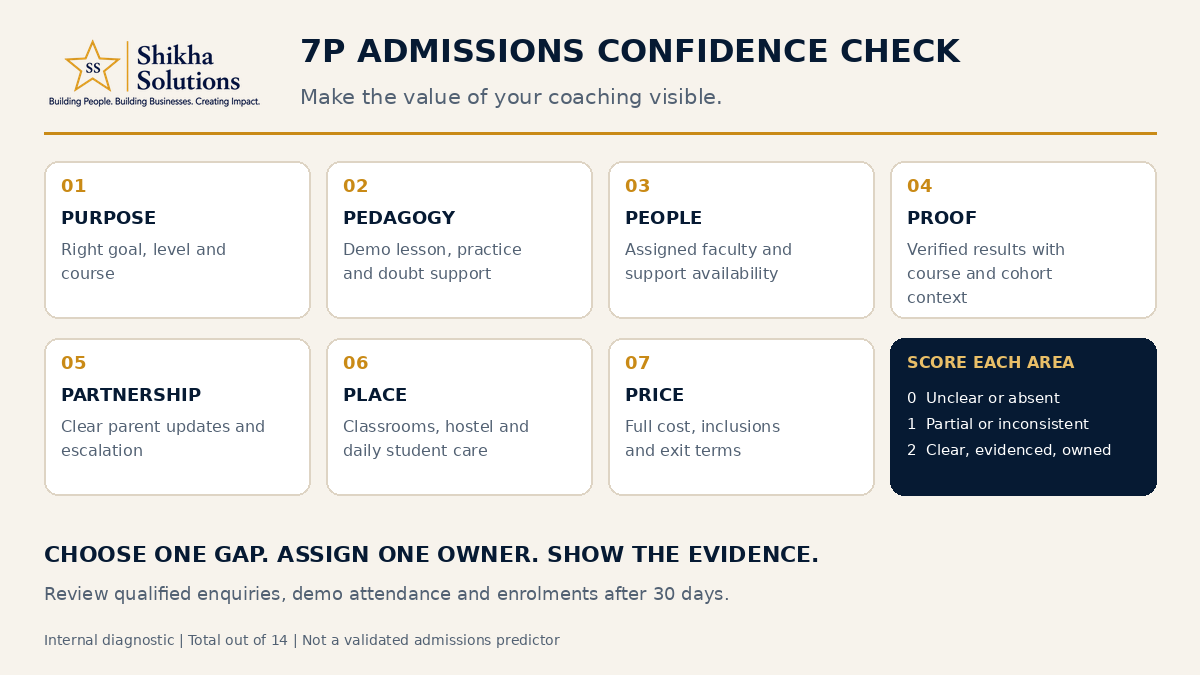
1. Purpose: is this the right course?
Understand the student’s goal, starting level, language comfort and available time. Explain prerequisites, course structure and realistic expectations. Recommend the appropriate batch, even when it is not the highest-priced option.
2. Pedagogy: can the student grasp the teaching?
Offer a short lesson with the actual teaching approach. Ask the student to solve or explain something afterwards. Show the learning cycle: teach, practise, check understanding, resolve doubts and revisit weak concepts. Explain revision and catch-up support.
3. People: who will teach and support them?
Introduce the assigned faculty’s relevant experience, batch size and doubt-support availability. Explain cover arrangements if a teacher is absent. A faculty profile should connect credentials with what the student will experience each week.
4. Proof: what results can you substantiate?
Use verified outcomes with their year, relevant course and cohort context. Where you show a success rate, state the numerator and denominator. Share anonymised progress examples where appropriate. Use student stories with permission and accurate attribution.
5. Partnership: how will parents stay informed?
Explain how attendance, assessments and concerns are communicated. Define who answers questions and when an academic concern is escalated. Agree communication with adult learners, rather than automatically sharing their information with parents.
6. Place: do facilities support daily learning?
Show classrooms, study space and essential facilities as they actually operate. If a hostel is offered or recommended, clarify ownership, supervision, food, transport, total charges and complaint handling. Explain what your institute controls and what a third party provides.
7. Price: is the complete commitment clear?
Provide a written breakdown of tuition, materials, tests, optional support and accommodation where relevant. Explain payment, exit and refund arrangements before enrolment. Value addition should make the student’s journey clearer, not hide extra charges.
Founder Action: a 15-minute admissions review
- Minutes 1–4: Take the last ten enquiries that did not enrol. Record the actual stated hesitation; mark unknowns honestly.
- Minutes 5–8: Map those hesitations to the seven Ps. Score your evidence and delivery, rather than your brochure.
- Minutes 9–12: Choose one recurring gap. Assign one owner and a deliverable: a real demo lesson, a clear hostel information sheet or a contextualised results page.
- Minutes 13–15: Set a review date. Track qualified enquiries, demos attended and enrolments by source and course over the next 30 days.
Keep admissions criteria and fee offers consistent during that review where possible. Record follow-up dates and reasons for not joining. A small sample can guide investigation; it cannot prove that one change caused higher conversion.
Make the next decision easier
Coaching sales improves when the admissions promise and the student experience become easier to connect. Start with one gap, strengthen the service behind it and show the evidence clearly. Follow up on the family’s unanswered question instead of simply asking for the payment again.
To see how your institute handles enquiries, counselling, follow-up and team ownership, take the free 12-question Coaching Growth Score. You can also calculate how many leads you need for your admissions target before increasing your marketing budget.
Sources
- Ministry of Education: Parliament Question—Regulation and Oversight of Private Coaching Institution, 12 August 2026.
- Central Consumer Protection Authority: action concerning misleading coaching advertisements, 15 May 2026.
- CCPA: Guidelines for Prevention of Misleading Advertisement in Coaching Sector, 13 November 2024. Background on transparent claims and student stories.