Articles

Build a business that doesn’t wait for you.

Practical observations for SME founders who want stronger ownership, clearer systems and more reliable execution—without adding layers of complexity their business does not need.

Latest Article

Practical ideas for a healthier business.

Start with our newest article, then explore the complete archive below.

All Articles

Explore the articles, newest first.

Browse every published article in descending publication-date order. Choose a business challenge that feels familiar and take one practical step.

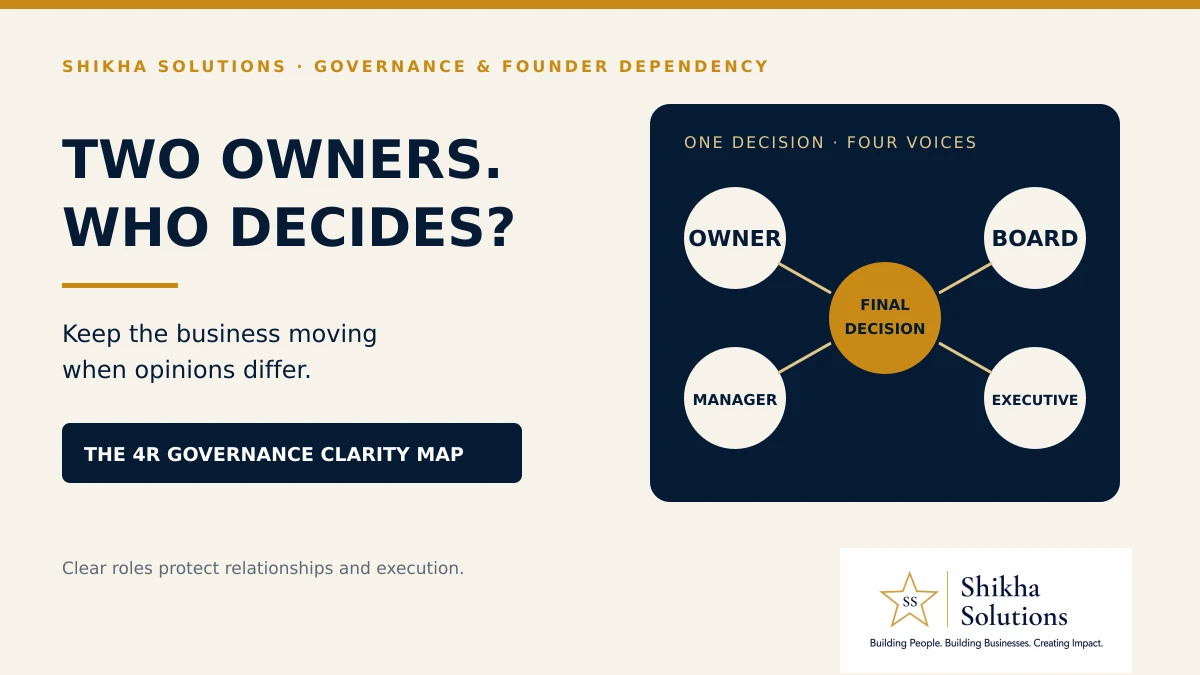
Four decision seats asking who decides when business owners disagree
· Governance & Founder Dependency

Who decides when business owners disagree?

Use the 4R Governance Clarity Map to prevent disagreement from stopping execution.

Read the article →
Sales made, cash received: find the handoff holding up customer payments
· Finance & Operations

Why are customers paying late even when sales are growing?

Use the 5C Invoice-to-Cash Check to locate invoice gaps, unclear follow-up and unmatched payments.

Read the article →
Indian SME founder and team reviewing how to redeploy time saved by AI
· AI, People & Operations

What should founders do with the time AI saves?

Convert released employee capacity into an owned, measurable business outcome with the 5R framework.

Read the article →
Indian business owner reviewing festive order capacity while a team prepares parcels for dispatch
· Operations · Profitable Growth

Is your business ready for festive demand?

Protect capacity, cash flow, fulfilment and customer trust before increasing seasonal promotions.

Read the article →
Aanant Goyal with the South sales team in Hyderabad
· Diagnose · Sales

Why your sales team cannot hit targets without you

Separate pipeline, capability, authority and founder-trust gaps.

Read the article →
Pictorial chart of founder dependency signs
· Diagnose · Indian SMEs

Founder dependency signs for SME businesses in India

Seven signs that routine work still stops with the founder.

Read the article →
Pictorial chart connecting business symptoms to the root constraint
· Diagnose · Root Cause

How to diagnose why a growing business is stuck

Move from the visible symptom to the operating constraint.

Read the article →
Aanant Goyal leading an Aravali Pharmacals conference and training session
· Execute · 90 Days

How to turn business problems into a 90-day execution plan

Use owners, SOPs, dashboards and 30/60/90-day reviews.

Read the article →
Aanant Goyal in a working meeting with an Indian SME leadership team
· Diagnose · Founder

How to stop being the bottleneck in your business

Convert repeated founder decisions into safe operating rules.

Read the article →
· Founder Dependency

Stop solving every problem. Make the decision repeatable.

Turn repeated founder decisions into clear authority, boundaries and learning loops.

Read the article →
· People & Teams

Your team may need a clearer finish line.

Define ownership through outcomes, practical goals and feedback.

Read the article →
· Process & Operations

Build processes people actually follow.

Improve everyday handoffs, SOP use and operating measurement.

Read the article →
· Sales & Growth

Give your sales target a weekly operating rhythm.

Create clearer qualification, next actions and pipeline reviews.

Read the article →
· Finance & Decision-Making

More numbers do not create better decisions.

Build a smaller dashboard that connects financial signals to action.

Read the article →
· Founder Dependency

Set safer boundaries for delegation.

Clarify authority, risk limits and escalation triggers.

Read the article →
· Execution

Close the gap after the meeting.

Turn priorities into owned deliverables and review dates.

Read the article →
Founder Action library

Choose one action to test this week.

Start with the problem that feels most familiar. Each action links to a focused guide so you can understand the diagnosis, use the tool and take the next step.

Founder Dependency

Turn repeated questions into decision rules.

Capture the question, the information used to answer it and the risk of a wrong call. Give the closest capable role a boundary they can operate within, then review the rule after two weeks.

Founder ActionCreate one decision rule using this sentence: “You can decide ___ up to ___; involve me only when ___.”
Open the founder-dependency guide →
People & Teams

Define ownership by outcome, not activity.

“Follow up with leads” sounds clear but produces different interpretations. “Every qualified lead has a dated next step by Friday” gives the owner and founder the same finish line.

Founder ActionRewrite one recurring responsibility as a visible outcome with an owner and review date.
Open the team-ownership guide →
Process & Operations

Fix the handoff where work slows down.

Most process friction sits between roles: sales to delivery, purchase to accounts, or manager to team. Start at the point where information is lost, work returns for correction or nobody knows who moves next.

Founder ActionChoose one delayed handoff. Agree the required input, receiving owner and expected turnaround time.
Open the process-handoff guide →
Sales & Growth

Review movement, not just the final number.

Revenue is a lagging result. A useful weekly review focuses on qualified opportunities, next actions, stalled deals and the reason each important deal will move—or will not.

Founder ActionFor the top ten opportunities, require one owner, one dated next action and one honest obstacle.
Open the sales-movement guide →
Finance & Decision-Making

Put the decision next to the number.

A metric is useful only when it helps someone choose an action. Keep the first dashboard small: cash position, collections due, gross margin signal, sales movement and one operating risk.

Founder ActionAsk of every number in your weekly review: “What decision changes if this moves up or down?” Remove metrics with no answer.
Open the finance-visibility guide →
Founder Dependency

Delegation fails when escalation stays vague.

Teams either escalate everything or hide issues too long when the trigger is unclear. A useful escalation rule defines the risk, time or money threshold that brings the founder back in.

Founder ActionSet one red-line trigger for a delegated area: customer risk, cash exposure, deadline slippage or reputational impact.
Open the delegation-boundaries guide →
Execution

End meetings with a visible commitment.

Discussion creates alignment; commitments create movement. Every priority should leave the room with one owner, one next deliverable and one review date that is already on the calendar.

Founder ActionEnd your next review by reading back only three things: owner, deliverable and date.
Open the execution-rhythm guide →

Find your first priority

Which gap is quietly becoming your next bottleneck?

Use the Business Health Assessment to review Founder Readiness, People & Accountability, and Systems & Growth. You will receive a personalised score, first priority and practical next step.