
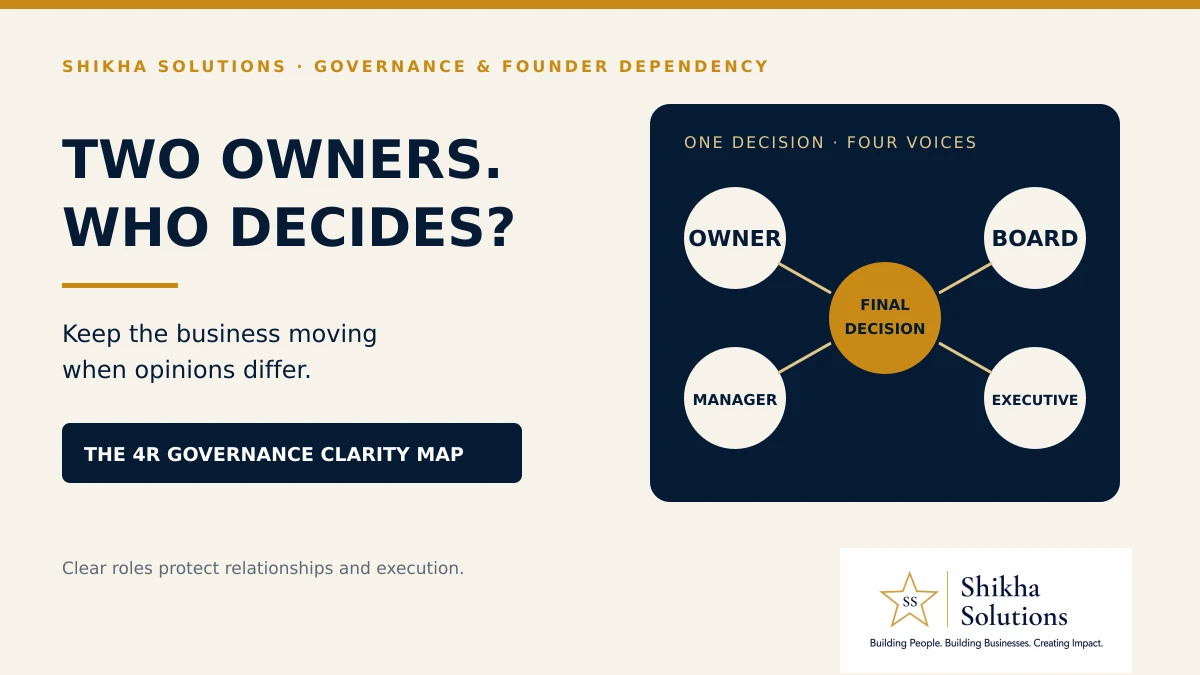
Direct answer: When owners disagree, the loudest voice should not automatically win. Decide in advance which matters belong to shareholders, the board, management or one accountable executive. Define the information required, the approval threshold and the deadlock route. Clear decision rights protect relationships, speed and business continuity.
What happened
Reuters reported on 22 September 2026 that a dispute at Tata Group had raised questions about shareholder rights and governance. The disagreement involves Tata Sons, its controlling shareholder Tata Trusts and board-level decisions concerning leadership, a possible listing and an exit route for another shareholder. Reuters reported that the Tata Sons board proceeded with proposals despite objections from the chairman of Tata Trusts, while governance advisers questioned how those decisions would ultimately survive a shareholder vote.
Those are the reported facts. The guidance below is Shikha Solutions’ interpretation for founder-led and family-owned SMEs—not a conclusion about who is right in the Tata dispute.
Why SME founders should pay attention
An SME may not have a large institutional board, but it can face the same underlying problem: people hold several roles at once.
A founder may simultaneously be a shareholder, director, chief executive and family member. A sibling may own shares but not work in the company. A professional manager may be responsible for results but still need approval from someone who is not involved in daily operations.
When these roles are mixed together, disagreements become personal very quickly.
A pricing decision becomes a question of trust. A hiring decision becomes a question of status. A dividend discussion becomes a debate about whose contribution matters more.
The operational cost is real:
- Managers wait because they do not know whose instruction takes priority.
- The same decision is reopened after it has already been made.
- Employees begin aligning with individuals instead of business priorities.
- Important information is shared selectively.
- The founder becomes the default referee for every unresolved issue.
The objective of governance is not to remove disagreement. Healthy businesses need challenge. The objective is to prevent disagreement from stopping execution.
What founders commonly misunderstand
1. Equal ownership does not mean every operating decision needs equal approval
Owners may deserve a voice on major matters without jointly deciding every discount, purchase or hiring action. Requiring consensus everywhere creates delay and weakens management accountability.
2. A job title does not automatically create authority
Calling someone a director, partner or CEO is not enough. The business still needs to define what that person may approve, what they must recommend and what remains reserved for owners.
3. Informal understanding works only while relationships are easy
“We will discuss it together” sounds collaborative but fails when opinions differ, time is limited or money is at risk.
4. Voting is not a complete deadlock plan
A 50:50 vote can leave the business stuck. Even with a majority, repeatedly overruling an operating leader can destroy trust and responsibility. A useful system defines what happens before conflict occurs.
5. Governance is not only a legal document
Shareholder agreements and board resolutions matter, but daily governance also requires meeting rhythms, decision records, information access and clear escalation.
The Shikha Solutions 4R Governance Clarity Map
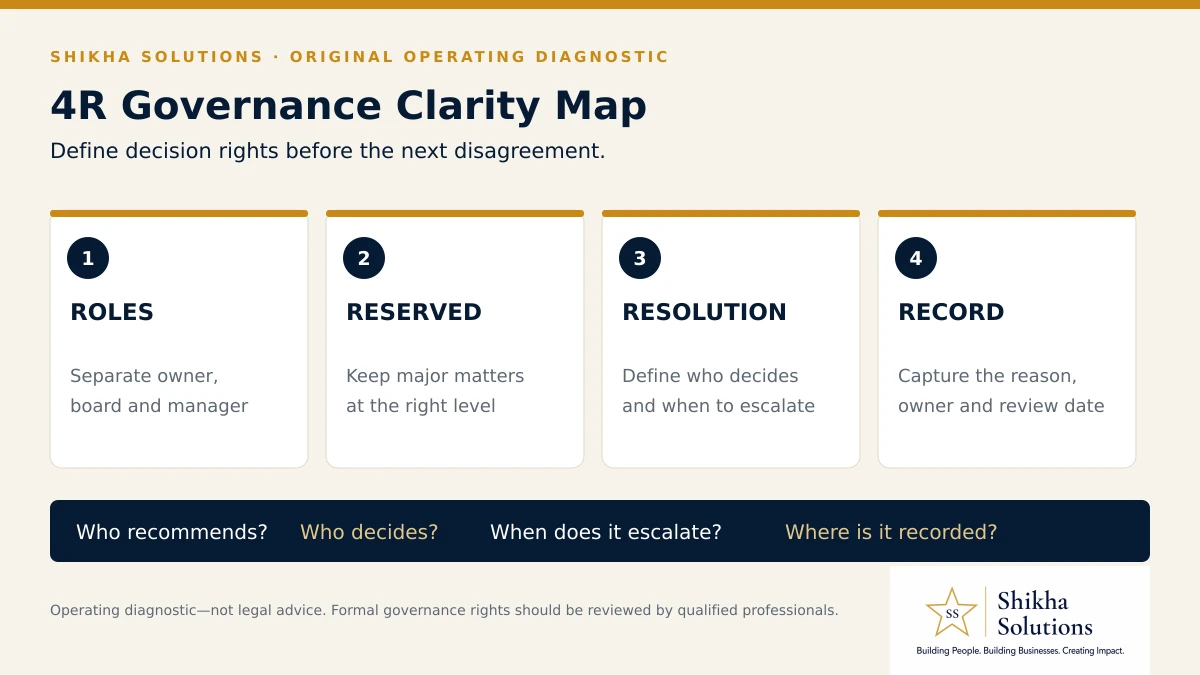
Use this framework for decisions that repeatedly create delay or conflict.
1. Roles
List the people involved and separate the roles they hold: owner, director, executive, functional leader or adviser. For this decision, which role is speaking?
2. Reserved matters
Identify decisions that genuinely require owner or board approval—such as major borrowing, equity changes, a new business line, senior leadership appointment or an unusually large capital commitment.
Everything else should have an accountable operating owner within a defined limit.
3. Resolution route
For each important decision, write the route when agreement is not immediate:
- Who recommends?
- Who decides?
- Who must be consulted?
- What financial, customer or legal threshold triggers escalation?
- What happens if the final authority is also conflicted or unavailable?
4. Record
Document the decision, rationale, owner, review date and conditions that would reopen it. A short decision log prevents memory, hierarchy or emotion from rewriting the agreement later.
This framework is an operating diagnostic, not legal advice. Formal ownership, board and shareholder rights should be documented with qualified legal and governance professionals.
Founder Action: a 15-minute decision-rights check
Choose one decision that has been delayed, debated repeatedly or reversed during the past month.
Draw four boxes labelled Roles, Reserved Matter, Resolution Route and Record.
Spend three minutes on each:
- Roles: Write every person involved and the role in which they should participate.
- Reserved matter: Decide whether this truly requires owner or board approval. If not, name the operating owner and their limit.
- Resolution route: Write who recommends, who decides and the one trigger that escalates the issue.
- Record: Write the decision, reason, owner and review date in one sentence.
Use the final three minutes to complete:
“For ___, ___ recommends and ___ decides within ___. Escalate only when ___. Record the decision in ___ and review it on ___.”
If you cannot complete this sentence, the business has a decision-rights gap—not merely a disagreement.
Final thought
Strong governance does not make every owner agree. It keeps the business moving when they do not.
Founders should be able to challenge one another without forcing employees to guess who holds authority. Owners should protect major decisions without becoming involved in every operating choice. Managers should be accountable for outcomes only when they have the authority to act.
Clear roles protect relationships. Reserved matters protect ownership. A resolution route protects speed. Records protect execution.
If recurring disagreements, unclear authority or founder approvals are slowing your business, take the free 15-question Shikha Solutions Business Health Check. It takes approximately three minutes and helps identify whether your first priority is founder readiness, people and accountability, or systems and growth.
Take the free Business Health Check.