
Quick answer: Customers may stop coming back because the experience around your product feels inconsistent. Slow replies, unclear bookings, uncomfortable waiting, missed commitments and silence after the sale can outweigh an otherwise good product. Audit the full customer journey and give each weak handoff a clear owner.
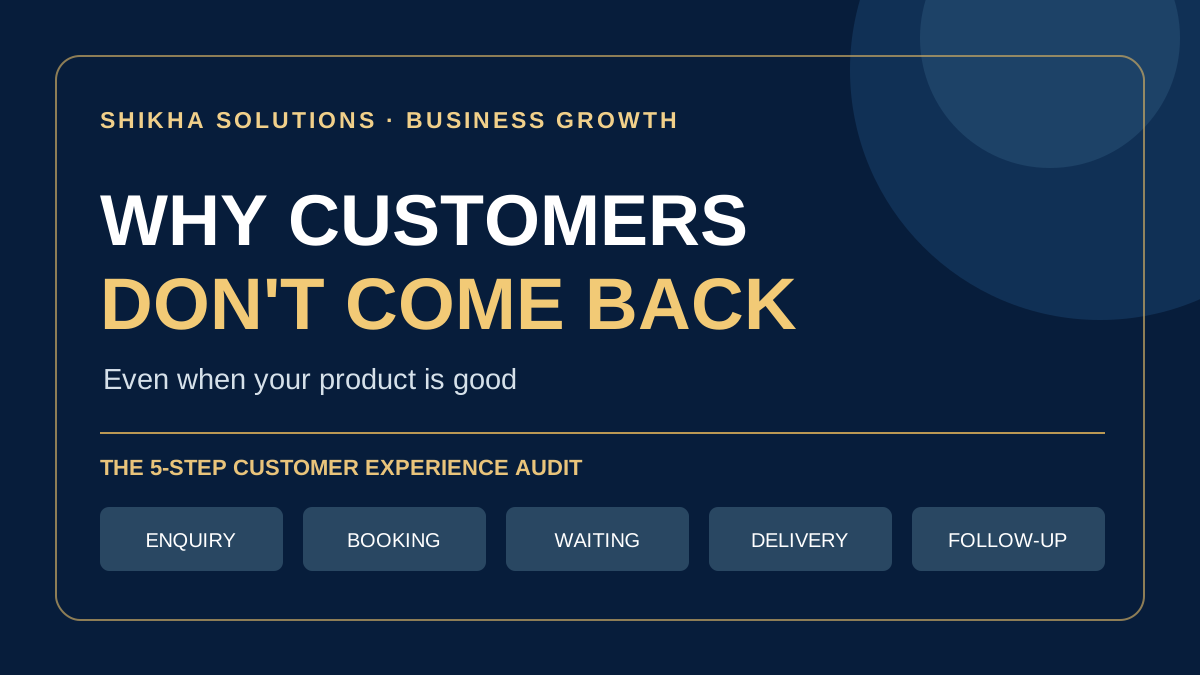
A good product is not the whole customer experience
Imagine a customer who likes your service but has to ask twice for confirmation. They arrive on time, then wait without an update. The actual service is good—but no one checks whether their original problem was resolved. A competitor may offer a clearer, calmer experience, and the next booking goes there. You might never receive a complaint.
This can happen in hotels, clinics, pet-care centres, retail shops, training institutes and B2B service firms. The details differ, but the question is the same: how easy do you make it for a customer to trust you again?
In PwC's 2025 Customer Experience Survey, 29% of surveyed consumers said they had stopped using or buying from a brand because of poor online or in-person customer experience. This is not a predicted loss rate for an Indian SME. Separately, CPA Australia's 2025–26 Asia-Pacific Small Business Survey identifies improved customer experience among the factors supporting growth in surveyed Indian businesses. Both findings reinforce the importance of the journey, not merely the sale.
Five customer touchpoints to check before spending more on ads
Walk through these steps as if you were a new customer. Ask your team what actually happens, not what the process manual says should happen.
| Touchpoint | What the customer experiences | Question to ask |
|---|---|---|
| 1. Enquiry | First response by phone, WhatsApp, website or walk-in | Who replies, when, and with which next step? |
| 2. Booking or buying | Availability, pricing, payment and confirmation | Does the customer understand what was agreed? |
| 3. Waiting and handoffs | Time between arrival and service, or between departments | Is the wait explained and reasonably comfortable? |
| 4. Delivery | The product or service, including problem resolution | Are our promises delivered consistently? |
| 5. After-sales | Issue closure, useful follow-up and an easy return journey | Do we close the loop without unwanted messages? |
Your 10-point Customer Experience Audit
Give each of the five touchpoints a score based on a few real customer cases:
0 points: No clear process, accountable owner or reliable evidence that this step happens.
1 point: The step usually happens, but depends on who is on duty.
2 points: There is a named owner, a clear standard and a way to verify completion.
Maximum score: 10 across all five steps. Record the lowest score and one observed reason behind it.
This is a simple self-assessment framework for discussion—not a scientifically validated benchmark. A score of 8/10 does not mean 80% customer satisfaction.
Example: A service business gives itself enquiry 2, booking 2, waiting 0, delivery 1 and after-sales 0. Its score is 5/10. Rather than spending immediately on more promotion, the team could fix waiting updates and after-service follow-up first. This example is illustrative, not a reported client outcome.
Founder vision and customer feedback belong together
A founder should decide what the brand promises and where it wants to go. Customers help reveal where that promise breaks down. Feedback should improve execution without forcing the brand to chase every individual demand.
Consider a premium pet-grooming business. Its vision might be expert grooming, not discounting. But pet parents may find a 35–45 minute wait uncomfortable. Better seating, realistic completion updates or a quiet place to work could reinforce the original vision. The lesson applies equally to a hotel guest, a patient waiting for an appointment or a parent evaluating an institute.
Vision sets the direction. Feedback shows where the journey needs repair. Use both, then prioritise what has the biggest recurring effect on customers.
Track repeat behaviour, not only new enquiries
Owners often know how many leads came in this week. Far fewer can quickly explain how many eligible customers returned after their first experience. Start with three modest measures, defined consistently:
- Repeat purchase rate: Number of customers who purchased again during a chosen period ÷ customers eligible to repurchase in that period. Keep the same cohort and time window.
- Open complaints: Issues awaiting resolution, with an owner and promised update date. Track age as well as count.
- Experience failure reason: One common friction category per reported problem—response delay, unclear price, wait, handoff, service mismatch or follow-up.
Don't assume every business has the same natural repeat cycle. A dental check-up, hotel stay and grooming appointment follow different rhythms. Compare similar customers and time windows before judging improvement.
A practical seven-day improvement plan
Day 1: Map the customer journey from first contact to return visit.
Day 2: Review five to ten recent customer interactions or complaints, with appropriate access and privacy safeguards.
Day 3: Score all five touchpoints. Identify the lowest-scoring one.
Day 4: Speak to frontline staff and customers who are willing to share feedback. Ask what caused effort or uncertainty.
Day 5: Fix one practical failure: a confirmation message, delay update, checklist or handoff.
Day 6: Assign an owner and a simple measure for that fix.
Day 7: Review a new sample of customer interactions and decide whether to keep, refine or replace the change.
Before buying more leads, fix one experience leak
Marketing brings people to the door. Repeat business depends on what happens after they arrive. Don't try to repair five problems at once. Pick the one customers feel most often, make responsibility visible and check the improvement weekly.
If you want to identify whether the bigger constraint is sales, team ownership or daily systems, take the free Business Growth Score. You can also book a free discovery call to discuss the first practical fix.
Research cited for context: PwC 2025 Customer Experience Survey and CPA Australia 2025–26 Asia-Pacific Small Business Survey. This article's five-step audit is a practical diagnostic, not a population-level research instrument. Customer consent and privacy requirements still apply.