
Quick answer: A full calendar does not prove a growing business. First locate where value stops moving: too few suitable enquiries, too few enquiries becoming orders, orders that are hard to deliver consistently, or sales that do not turn into usable cash. Measure one stage, assign an owner and fix that constraint before adding more activity.
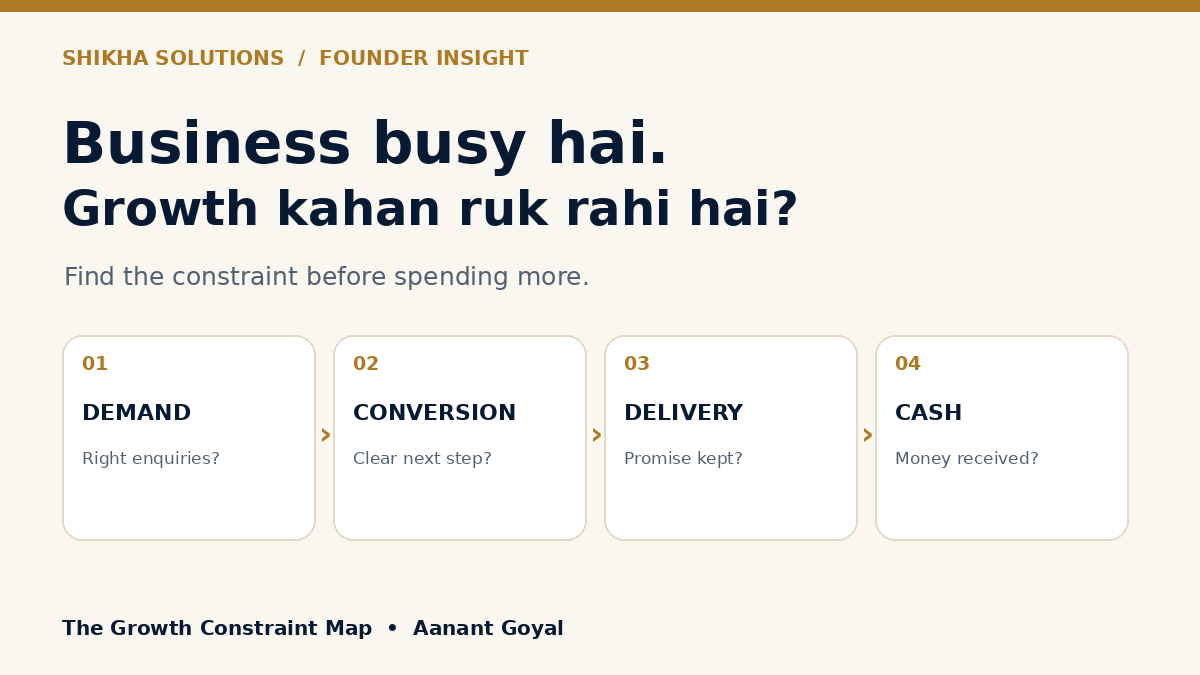
“We are working all day” is a symptom, not a diagnosis
The founder is answering calls. The team is creating content, sending proposals, following up on WhatsApp and solving customer complaints. Yet at the end of the month, growth still feels uncertain. The natural response is to do more: more ads, another salesperson, a new branch, a bigger CRM.
Those decisions can be right. They can also put more pressure on the very stage that is already failing. If good enquiries are waiting for a callback, more advertising adds a queue. If orders are coming in but delivery keeps slipping, another salesperson adds promises the team cannot yet keep.
Before choosing a solution, ask a narrower question: where does an opportunity stop becoming value?
The Shikha Solutions Growth Constraint Map
Look at the last 30 days. Use your own register, invoices or call log; a simple sheet is enough. This is an operating diagnostic, not an industry benchmark. Count consistently and write down anything you cannot yet measure.
1 · Demand: Are the right people reaching us?
Record enquiries by source and note which fit your offer and service area. If suitable enquiries are genuinely scarce, improve the offer’s clarity, referral relationships and visibility. A high enquiry count filled with poor-fit requests is not healthy demand.
2 · Conversion: Do suitable enquiries become decisions?
Check how many qualified enquiries receive a timely first response, an agreed next step and useful follow-up. Listen for recurring objections: price, trust, fit or timing. If interest exists but decisions stall, repair the sales conversation and ownership before buying more reach.
3 · Delivery: Can the team keep the promise?
Look at promised dates versus actual delivery, unresolved issues and rework. If orders are won but the founder must intervene to complete them, clarify handoffs, capacity and escalation. More sales will not create a repeatable experience by itself.
4 · Cash: Does the work produce usable money?
Compare invoiced value with collections, direct costs and the time before cash arrives. A profitable-looking order may still strain the business when money remains tied up in receivables or stock. Ask your accountant to verify margin and cash calculations before making a large spending decision.
These stages connect, but they are not interchangeable. Google Ads’ conversion guidance distinguishes actions such as calls and sign-ups from business outcomes you choose to value. Australia’s government small-business cash-flow guide likewise recommends keeping records of sales and costs and reviewing the movement of cash. Our four-stage map is Shikha Solutions’ interpretation for founder decisions; neither source endorses this framework.
What founders commonly misread
“Leads are down, so ads are the answer.” Maybe. First separate suitable enquiries from every message or click. Then check whether the team responds to and progresses the suitable ones already arriving.
“The team is busy, so we need to hire.” Busy can mean demand has exceeded capacity. It can also mean duplicate work, unclear approval or the same task returning to the founder. Observe a week of handoffs before writing a job description.
“Revenue is up, so we are growing.” Revenue matters, but delivery effort, margin and collection timing determine whether growth is sustainable. A rise in orders accompanied by more rework and slower payments deserves investigation.
Do not turn these into a universal rule against ads or hiring. The point is to make the next decision from evidence that matches the actual bottleneck.
Founder Action: a 15-minute constraint check
Minutes 0–4: Write down the last 30 days’ suitable enquiries, orders won, orders delivered on time and cash collected. If a number is unavailable, mark it “unknown” rather than guessing.
Minutes 4–8: At each stage, name the person who owns the next action. Ask where opportunities wait, return to you or lose information.
Minutes 8–12: Choose the weakest handoff with evidence behind it. Write one small change you can trial next week: a callback owner, a proposal review, a delivery checklist or an invoice follow-up date.
Minutes 12–15: Set a review date and one measure. For example, “qualified enquiries with a documented next step,” not “team should try harder.”
If two stages look weak, start with the one that makes the other stage harder. Poor delivery can depress referrals; slow collections can limit the ability to market. You are looking for an order of work, not a perfect dashboard.
Make the next move smaller and clearer
A business can be busy because it is growing, or because it is repeatedly repairing the same broken handoff. You do not need a bigger plan to tell the difference. You need a few reliable numbers, an honest team conversation and one owner for the next improvement.
If you are unsure where to begin, take the free 15-question Business Growth Score. It takes about three minutes and helps you identify whether sales, team ownership or operating systems need attention. Then use the Growth Constraint Map to check that answer against your own numbers.
Sources and scope
- Google Ads Help — About conversion measurement: context for measuring valuable actions rather than only traffic.
- Australian Government — Guide to managing cash flow: context for sales, costs and cash records.
The Growth Constraint Map and 15-minute exercise are original Shikha Solutions diagnostics. No industry-wide conversion rate or client result is claimed here.